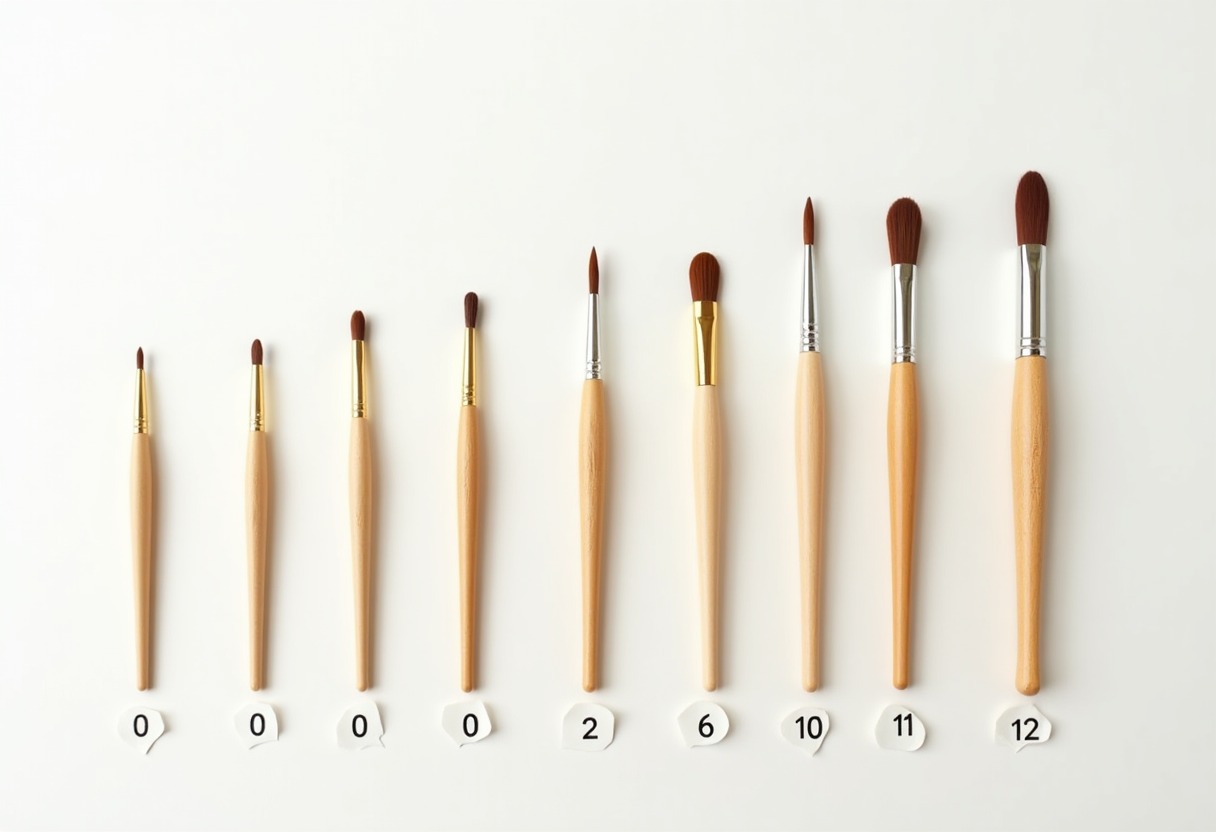
Walk into any art supply store and you'll see brushes numbered 000000 through 24, sometimes with half-sizes thrown in. The numbering feels arbitrary until you understand that these numbers relate directly to the ferrule diameter and bristle length—a standardized system that's surprisingly consistent across manufacturers, though never perfectly so.
Why Brush Numbers Matter More Than You Think
Brush manufacturers size their products using a numbering system where larger numbers generally indicate larger brushes. A size 2 round holds more paint than a 0, which holds more than a 00. But here's where it gets specific: the International Organization for Standardization hasn't actually standardized artist brush sizes, which means a Winsor & Newton size 2 might measure slightly differently than a Princeton size 2.
What stays consistent? The relationship between numbers within each brand's lineup. A manufacturer's size 4 will always be roughly twice the width of their size 2. This proportional consistency matters more than absolute measurements when you're building a brush collection for Best Brushes Miniature Painting 2026 or traditional canvas work.
The numbering also changes based on brush shape. A size 2 round has a completely different working area than a size 2 flat—the flat will cover more surface while the round offers more precision. Understanding both the number and the shape lets you match tools to tasks instead of guessing.
Decoding Brush Numbers: The Core System
Round brushes use numbers from 000000 (20/0) up to 24 or higher. Most painters work in the 000 through 12 range. Flats, filberts, and angular brushes typically run from 0 through 24, measured in both numbers and imperial sizing (1/8", 1/4", 1/2", etc.) for larger brushes. → Shop paint brush set numbered on Amazon
The smallest sizes—000000 through 0—work for fine lines, tiny details, and controlled dots. These appear most often in miniature painting, botanical illustration, and anywhere precision trumps coverage. A 20/0 brush might have only 3-5 hairs at the tip.
Sizes 0 through 4 handle most detail work across painting disciplines. You'll use a size 1 round for small shapes, edges, and controlled strokes. A size 4 works for medium details and can still hold enough paint for smooth application without constant reloading.
Sizes 6 through 12 cover basecoating, glazing, and general painting tasks. A size 8 round or flat becomes a workhorse for canvas painting—large enough to cover area but small enough for control. These middle sizes bridge the gap between detail and coverage.
Sizes 14 and up serve backgrounds, large washes, and broad coverage. You'll find these more in traditional painting and less in miniature work. A 1" flat (roughly size 20) can knock out a canvas background in minutes. → Shop flat brush set sizes on Amazon
Brush Size Chart: Matching Numbers to Tasks
| Brush Size | Best Applications | Paint Type Fit | Typical Painting Area | |------------|-------------------|----------------|----------------------| | 000-0 | Eye details, fine lines, signatures, miniature highlights | All, thinned | Smaller than 1mm width | | 1-2 | Small details, edges, controlled strokes, miniature basecoats | All | 1-3mm width | | 4-6 | Medium details, small areas, glazing, blending on small surfaces | All | 3-6mm width | | 8-12 | Basecoating, general painting, medium washes, canvas details | All | 6-15mm width | | 14+ | Large areas, backgrounds, broad washes, canvas coverage | Acrylics, oils | 15mm+ width |
This chart applies to round brushes. Flats and filberts in the same numerical size will cover more area but sacrifice tip precision. A size 6 flat handles the workload of a size 8-10 round for coverage but can't match the detail control.
When choosing brush size, factor in your paint consistency too. Thicker paint needs a larger brush to flow properly—a size 0 loaded with heavy-body acrylic will drag and skip. The same paint thinned down works smoothly through that small brush. This connects directly to How To Thin Acrylic Paint Viscosity Thinning Ratios principles.
For miniature painters, the 0-6 range handles 90% of tasks. Canvas painters typically stock 2-12 for detailed work plus 14-20 for coverage. → Shop round paint brushes assorted sizes on Amazon
Practical Size Selection for Common Painting Scenarios
Miniature painting relies heavily on sizes 0-2 for most figure work. You'll reach for a 00 or 000 for eyes and fine freehand, but overusing tiny brushes causes hand fatigue and slow progress. A size 1 with a good point handles more than you'd expect—use the tip for details and the belly for small surfaces. Size 2 works for larger armor plates and cloaks. Check out How To Paint Eyes for specific techniques with these smaller sizes.
Canvas painting spans a wider range. Start basecoats and backgrounds with size 12-20 flats, then switch to 6-8 rounds or filberts for major shapes and forms. Drop to size 2-4 for details and refinements. A 1" or 2" flat makes quick work of initial coverage, especially when working with gesso as explained in Best Canvas Priming Techniques Acrylic Gesso Vs Oil Ground Vs Commercial Primers.
Watercolor work demands brushes that hold maximum water. Round sizes 8-12 handle most painting, with those larger brushes holding enough water for sustained strokes. Drop to size 4-6 for details. The larger size compensates for watercolor's fluid nature—you're not just applying pigment, you're controlling water flow.
Detail brushes (sizes 000-0) work best for controlled spots of paint, not extended strokes. Use them for pupils, highlights, small text, or jewelry details. Switch to a size 1 or 2 once you need to cover any real area. The smallest brushes don't hold enough paint for smooth coverage—they're strictly accent tools. → Shop detail painting brushes small on Amazon
What Most Brush Size Guides Miss
Brush size selection changes with paint opacity and coverage needs. Translucent glazes work through smaller brushes than you'd use for the same area with opaque paint. A size 2 can glaze over a 1" area in multiple thin layers. That same brush would struggle with opaque coverage beyond a few millimeters. This connects to color theory and layering principles covered in Warm Vs Cool Colors Painting Master Color Temperature Techniques.
Your painting posture affects optimal brush size too. Miniature painters working at close range with magnification can control smaller brushes. Canvas painters standing at an easel 2-3 feet from their work need larger brushes to maintain the same precision—you can't effectively control a 000 brush from arm's length.
Brand quality matters more as size decreases. A cheap size 12 flat still spreads paint. A cheap size 0 round loses its point after three strokes, splitting and splaying instead of maintaining the fine tip you paid for. Invest in quality where precision matters. See Natural Vs Synthetic Brushes Guide for material considerations at different sizes.
The gap between sizes isn't linear. The difference between 000 and 0 is subtle. The jump from 4 to 6 is noticeable. The leap from 10 to 14 is dramatic. Don't expect even increments—test brushes before buying a full range. Many painters find half-sizes (1/0, 3/0) unnecessary and stick to whole numbers without losing capability.
Proper brush maintenance extends size accuracy. A well-maintained size 2 keeps its point and effective size for months. A neglected one loses shape within weeks, essentially becoming a smaller, worse brush. Follow the guidance in Brush Care Maintenance Guide to maintain your brushes' true size and performance. → Shop artist brush size chart on Amazon
FAQ
What does the number on a paint brush mean? The number indicates relative size within a manufacturer's line, with larger numbers generally meaning larger brushes. A size 6 is bigger than a size 2, which is bigger than a 0. The system isn't standardized across brands, but proportional relationships stay consistent within each brand's range.
What size brush should beginners start with? Start with sizes 2, 4, and 8 in both round and flat shapes—six brushes total. This range covers detail work, general painting, and larger areas without overwhelming your budget. You can expand up or down once you identify what you actually reach for most often.
Can I use a large brush for small details? You can use the tip of a larger brush (size 4-6) for details if it maintains a good point. Quality rounds in these middle sizes often work better than tiny brushes because they hold more paint while still offering precision. The extra paint reservoir means smoother, more controlled strokes.
Why do some brushes have numbers like 00 or 000? These indicate sizes smaller than 0, with more zeros meaning smaller brushes. The sequence runs 0, 00 (or 2/0), 000 (or 3/0), up to 000000 (20/0) for the tiniest detail brushes. Each additional zero represents approximately one step smaller than the last.
Do all brush shapes use the same numbering? Yes, but the same number means different coverage areas for different shapes. A size 4 round, size 4 flat, and size 4 filbert all use the same base measurement, but the flat covers more area while the round offers more precision. Always consider both number and shape when selecting brushes.
Match Your Brushes to Your Actual Work
Size numbers give you a framework, but your painting style and subjects determine what actually lives in your brush jar—build your collection around what you paint most, not what a chart says you need.
Some links on this page are affiliate links. We may earn a small commission if you purchase through them, at no extra cost to you.
As an Amazon Associate we earn from qualifying purchases. This article contains affiliate links; if you buy through them we may earn a small commission at no additional cost to you.